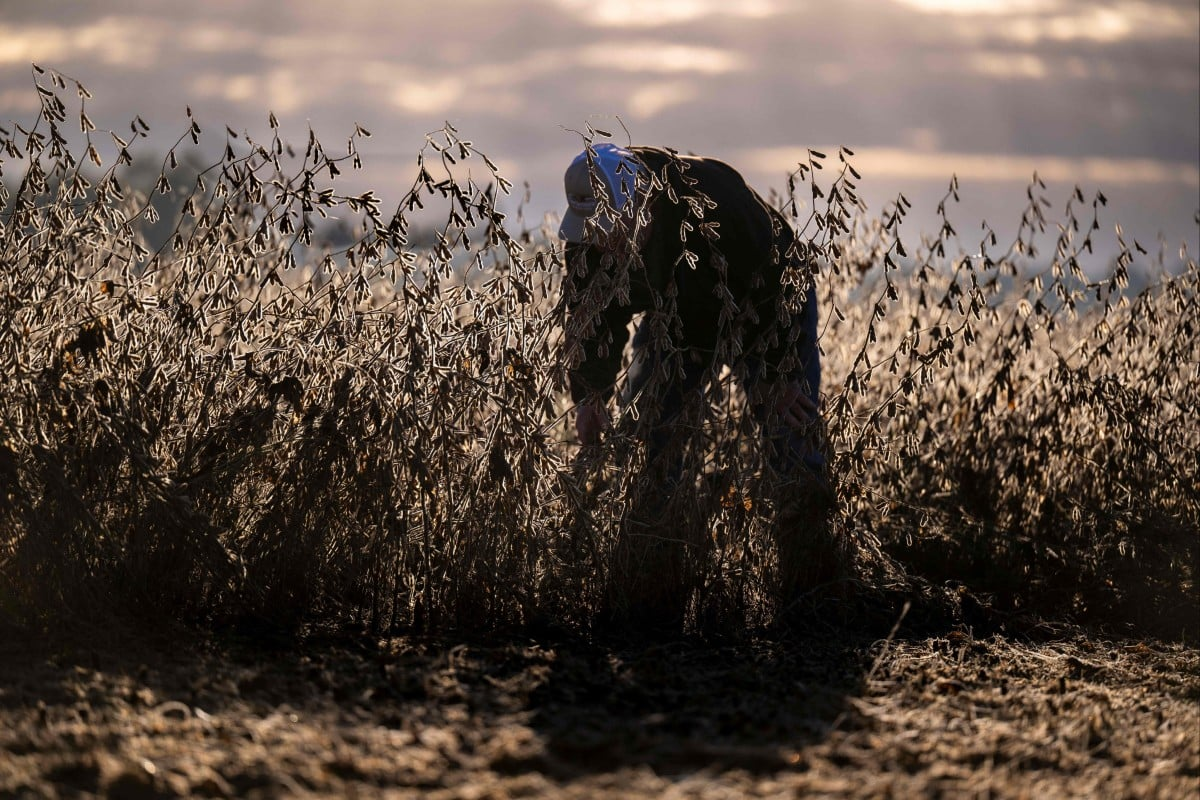
US President Donald Trump has announced a long-anticipated US$12 billion farm aid package to assist farmers caught in US-China trade tensions, crediting his tariff strategy for making the bailout possible and asserting that his negotiations with China had led to the resumption of massive soybean sales.
But the announcement has not pleased all farmers, particularly those still struggling with low prices and lost markets. Some said it was too little, too late, and that a bailout wouldn’t be necessary if there were no tariffs.
John Bartman, a soybean farmer from Illinois, said the aid was a “drop in the bucket” and “roughly the same amount of money that China would have purchased in a normal year anyway”.
“It’s just the stupidity of the whole situation that we’re in this mess. And why is China not upholding their end of the bargain? Why do we have to have this payment in the first place?” he added.
US Agriculture Secretary Brooke Rollins said the government will issue US$11 billion in direct “bridge payments” to crop farmers by the end of February 2026, while holding back US$1 billion to assess needs among speciality crop producers.
While blaming his predecessor Joe Biden for the “total mess” and “highest inflation”, Trump said that the aid would not be “possible without tariffs” and called $12 billion “a lot of money”.
“This money would not be possible without tariffs. The tariffs are taking in, you know, hundreds of billions of dollars, and we’re giving some up to the farmers because they were mistreated by other countries for maybe right reasons, maybe wrong reasons,” Trump said during a roundtable at the White House.
Citing the lawsuit brought by a group of small businesses against a large chunk of his tariffs, Trump added that “bad people” and “some real sleazebags” were trying to take the levies away. “The decision of the Supreme Court is a very important thing,” he said.
In November, the higher court heard oral arguments in the case, which asserts that the executive lacks the power to impose sweeping tariffs by declaring a national emergency. A verdict is widely expected in the first half of 2026. Trump imposed hefty tariffs on all trading partners earlier this year using the International Emergency Economic Powers Act.
On Monday, Trump did not specify if tariff revenues would fund the entire bailout. In September, he had proposed using tariffs to support farmers. However, if the US Supreme Court finds his tariffs unconstitutional, he may be barred from using that money to finance aid packages.
The aid comes after months of anger and frustration among farmers over losing access to the Chinese market due to Trump’s tariff policies. China is the world’s largest soybean buyer and has been a major client for US soybean growers since the early 2000s, purchasing between half and two-thirds of US soybean exports.
During his first term, after Trump began a unilateral trade war against China in 2018, Beijing retaliated with its own tariffs on US agricultural products, primarily soybeans, while also moving some orders to Brazil. At the time, Trump doled out $28 billion in farm aid for affected farmers in 2018 and 2019 combined.
After Trump slapped new tariffs on Chinese imports early this year, Beijing did not place a single order until October and bought instead from Brazil.