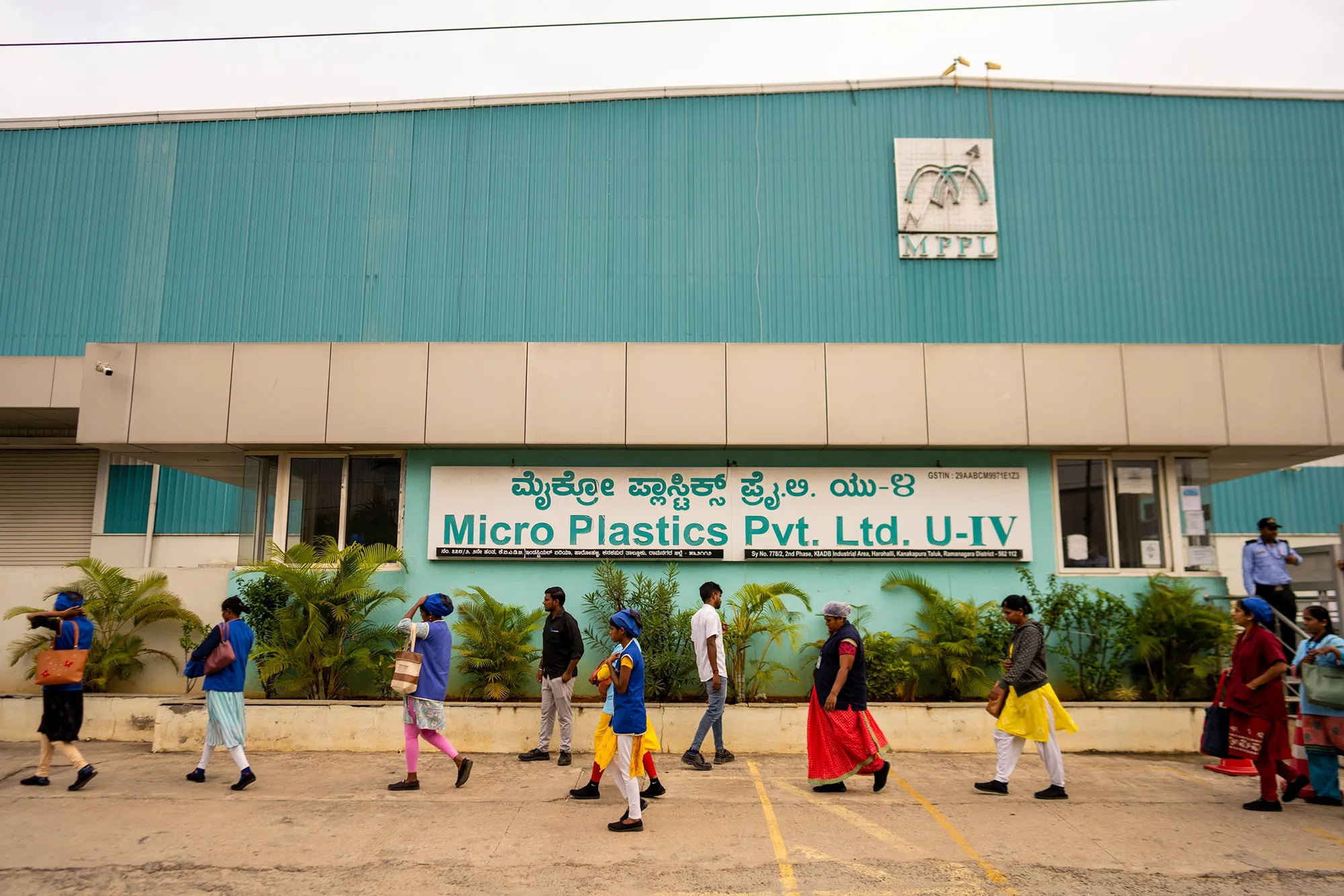
Three years ago, Vijendra Babu opened India’s largest toy factory, a two-story building with enough space to play 11 football games simultaneously. The plant near Bangalore was a revelation for India at the time, offering a one-stop shop that could engineer toys, cut steel molds for their production and manufacture them. At the time, the $30 million investment seemed ambitious but not absurd: Babu’s business was almost doubling every two years. These days, he’s wondering whether he did the right thing. “We had plans to expand,” says Babu, managing director of Micro Plastics Pvt Ltd. “Now we will have to see how this affects all that.”
“This” is US tariffs of 50% on Indian goods, which President Donald Trump announced on Aug. 6 to punish India for purchasing Russian oil. Babu’s company had been prospering, with contracts from global giants such as Hasbro, Mattel and Spin Master to churn out Nerf guns, Paw Patrol trucks and thousands of other products sold in big-box stores worldwide. But now, when the loading docks should be dispatching a dozen or more trucks a day with containers full of Christmas cheer, the warehouse is eerily quiet.
Rows of shelving from floor to ceiling are filled with blue plastic bins. Each is encased in plastic wrap, holding a sample of what’s inside—a partially completed dollhouse, water pistols, the shell of a miniature black sports car. “These are all half-finished products,” Babu says. He then grabs his phone and dials another warehouse he owns, about an hour away. Asking the manager there to pan his phone’s camera across the facility, almost 50% bigger than the one we’re in, he shows more bins of goods piled on shelves and stacked on the floor—packed and ready to be shipped when tariffs decline. “They’re all stuck, waiting for export,” he says as he ends the call. “There’s not enough space for our stuff.”
he unfinished toys were yanked off assembly lines after Trump imposed the tariffs, which are now higher than those on China. Across India, the seesawing trade policy has frozen new business, with Babu’s customers putting orders on hold or canceling them outright. He estimates he’s sitting on as much as $20 million in goods he can’t ship, and he says new orders valued at some $15 million are on hold. “It’s kind of a pause as we rework our strategy,” Babu says. “But these things cannot be done overnight.”
For decades, the logic of manufacturing was simple: Make it cheap, make it fast and make it in China. But the trade wars that began during Trump’s first term shattered that formula, setting off a race by Western companies to find new manufacturing hubs. There was so much demand from US companies that Babu, backed by private equity money, this year completed construction of a 250,000-square-foot facility next to the one where he’s standing. It’s now empty. “We should have opened, and we should be getting the machines in,” he says.
Babu was projecting 40% growth this year, but he’s more likely to see a 15% drop, and he’s bracing for a further decline in 2026. For some long-standing customers, he’s even agreed to make products at cost just to keep the assembly lines moving and avoid laying off any of his 2,000 workers. “What happens with orders now is critical, because that will be production for next year,” he says. Cancellations mean “all of our expansion plans will be put on pause.”
A three-hour flight to the north, just outside New Delhi, it’s easy to see the improbability of Trump’s argument that tariffs will bring back manufacturing jobs. Amitabh Kharbanda, owner of the Sunlord toy factory, proudly shows off what he calls his company’s “Trump card,” his handwork department, which couldn’t realistically be replicated in the US. Dozens of women dressed in colorful tunics sit in rows, hand-sewing strings of 3-foot-long yellow yarn onto the heads of what will become all-fabric Elsa dolls from the Disney film Frozen. Others trim the hair, comb it out and then meticulously hand-braid it into an intricate fish-tail pattern. It’s painstaking and rigorous, requiring about 40 minutes just for the doll’s hair.
When you add in sewing the blue beaded dress and tulle cape, stuffing the fabric body and embroidering the eyes, mouth and nose, each doll requires about four hours of manual labor. “You couldn’t move that to America at a commercially viable price,” he says. The Elsa doll retails for about $60. Factory workers in India earn about 20,000 rupees ($220) a month. If a US company were to pay only the federal minimum wage of $7.25 an hour (in most states, it’s higher), the manual labor alone would account for almost half of that $60—in a business where retailers typically take a third or more of the final price. And that’s assuming Americans could ever attain the skill levels reached at a factory where 70% of the 225 employees have been working for more than 25 years. “This has to be done by hand, and the more experienced, the better the results,” Kharbanda says. “It’s impossible to do it by any kind of automation.”
India, of course, knows a thing or two about tariffs. For decades it was among the most protected economies in the world. Critics of what was called the “License Raj”—the period after independence in 1947 when the government required permits for nearly all business activities—argue that with little exposure to the global economy, the country’s manufacturers got flabby and inefficient. Then in 1991, India flung the doors open, and by the early 2000s the shelves of its toy shops were filled with imports—most from China. In 2020, Prime Minister Narendra Modi’s government launched a “National Action Plan for Toys” aimed at bolstering the sector. Tariffs on imported toys were increased from 20% to 70%, and the government introduced safety certifications and quality standards to boost the industry’s export prospects.