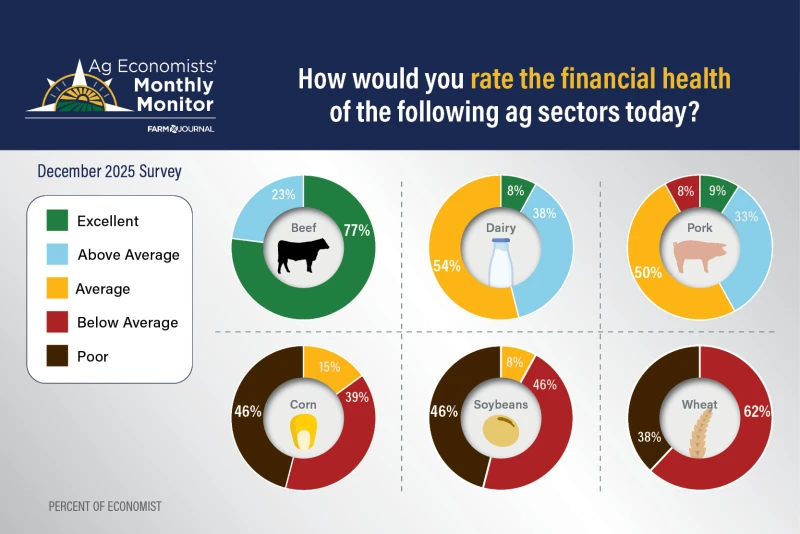
As 2026 ushers in a fresh start, agricultural economists say the U.S. farm economy has stopped sliding, but it’s far from fully healed.
The December Ag Economists’ Monthly Monitor shows month-to-month sentiment is improving, but deep structural strain remains — especially in row crops. Meanwhile, livestock markets continue to provide strength. Crop producers face another year of tight margins driven by high input costs, weak prices and unresolved trade and policy uncertainty.
“There’s cautious optimism,” the economists say, “but very little belief that 2026 will bring a meaningful rebound without cost relief or stronger demand.”
Those themes mirror the perspective of Seth Meyer, former USDA chief economist and now director of the Food and Agricultural Policy Research Institute (FAPRI) at the University of Missouri. In a recent interview, Meyer connected the dots between narrow margins, policy responses and what might actually move the dial for U.S. agriculture heading into 2026.
Economists see the ag economy holding its ground — but not gaining strength.
- 54% say the ag economy is somewhat better than one month ago.
- Compared with a year ago:
- 42% say conditions are worse
- 33% say they are better
- Looking ahead 12 months:
- 46% expect conditions unchanged
- 38% expect improvement
- 15% expect conditions to worsen
“Momentum has improved since mid-2025,” Meyer notes, “but tight margins have been with us for a long time. Turning that around requires demand growth, not just price stabilization.
Grant Gardner, assistant Extension professor at the University of Kentucky, tells AgriTalk’s Chip Flory: “I think as we move into kind of this next marketing year, you’re looking at what looks like a breakeven and not a loss, but breakeven still doesn’t look great after three years of breakeven or losses.”