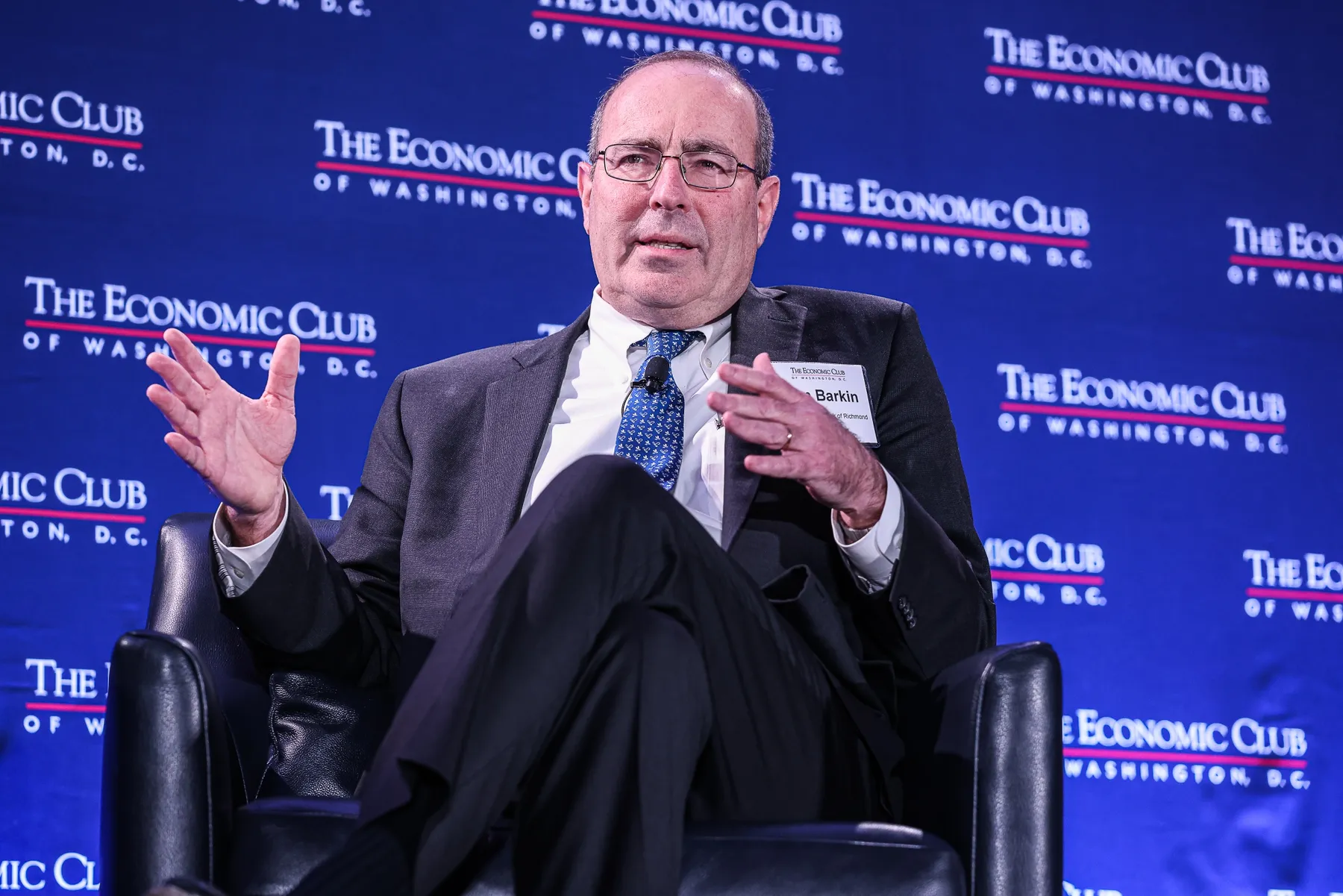
Federal Reserve Bank of Richmond President Tom Barkin said last year’s interest-rate reductions have helped bolster the labor market as officials now look to bring inflation back down to the central bank’s target.
“I think of these cuts as having taken out some insurance to support the labor market as we work to complete the last mile to bring inflation back to target,” Barkin said Tuesday at an event in Columbia, South Carolina.
Barkin said the economic outlook is improving as uncertainty fades, but risks remain with hiring concentrated in a few sectors and inflation still running above the Fed’s 2% goal.
Fed officials left their benchmark unchanged last week in a target range of 3.5% to 3.75%. Fed Chair Jerome Powell said policy is well positioned for officials to respond to risks facing employment and inflation after pollicymakers made three consecutive rate reductions last year.
Barkin said the uncertainty caused by tariffs and other policy changes last year is beginning to fade in 2026. He said businesses he has spoken with are reporting steady demand. Barkin also expects tax refunds, lower gas prices and looser monetary policy to support the economy this year.
The Richmond Fed chief reiterated that stretched consumers are pushing back on businesses’ efforts to pass along tariff costs through higher prices, and that’s helping contain inflation.
He also cautioned that while demand in the US economy has proved resilient overall, it was largely due to the buildup of infrastructure for artificial intelligence and spending by wealthy consumers, two factors that he linked.
“These two segments are connected,” he said. “Easing in the AI space could hit business investment and the stock market, which in turn could hit consumption by the wealthy should their net worth decline.”
Speaking to reporters after his speech, Barkin said officials have more work to do on both the employment and inflation sides of their mandates.
Responding to a question on immigration, Barkin said the unemployment rate has remained relatively stable as job growth slowed. He pointed to the possibility that demand for labor and its supply could both turn negative in the coming months. “That would be okay from a maximum employment standpoint,” he said. “That’s just not a very attractive economy.”
Regarding prices, Barkin reiterated that inflation has been above the Fed’s target for about five years. He said it’s possible to see a scenario where restrictive policy brings inflation down, and a different outcome in which inflation gets stalled above target.
The Richmond Fed chief also said he looks forward to working with Kevin Warsh, whom President Donald Trump said he intends to nominate to lead the central bank when Jerome Powell’s term as chair expires in May.
“I don’t know him well,” Barkin said. “He’s obviously a very charismatic person. He’s seems to me to be capable. I respect him, and I look forward to working with him.”
Asked about how the Trump’s insistence that the next Fed chair lower interest rates might affect his interpretation of that person’s policy recommendations, Barkin said he will remain focused on his job.
“I personally am going to show up and try to do the job that Congress asks us to do as best I can,” he said. “And I trust and expect that’s what the chair will do too.”